
Our Campsite Lighting Setup: Balancing Visibility and Safety with Dark Sky Etiquette
When discussing camp gear, we often see guides talking about the big-ticket items, like the best tent, dining shelter, camp stove, or camp chair.
But there’s one piece of gear that I feel is equally as important and worthy of a little research, and that’s your lighting.
Whether you’re trying to cook after dark or taking your pup out for a late-night pee, the right lighting serves an important role both in safety and comfort for you and your pets.
Of course, there are a million different options out there for lanterns, flashlights, and other lighting solutions. It can make it difficult to know what will work when you need it most.
To help kickstart your research and shopping, I’m going to break down what lighting options you should consider, the exact products we use when camping with our “pack,” and a few campsite etiquette considerations to keep in the back of your mind.
Some items in this gift guide were provided to us by the brand for consideration, but the opinions shared about these products are our own. This post contains affiliate links, which means if you click and buy, we will make a commission (at no cost to you). See our full disclosure policy for more details.
Lighting the Campsite
There are two types of lighting to consider at the campsite during your trip:
- Ambient lighting: allows you to navigate your campsite easily; comfortable lighting for when you’re just hanging out on the site without straining your eyes
- Task-specific lighting: for when you need a little extra help seeing what you’re doing when working on a specific task, like cooking
While some lanterns fit both categories, most camping lanterns are best suited to one purpose or the other.
With that in mind, we pack separate products for each of those purposes.
Ambient Lighting
Unlike some people who need brighter lighting around the campsite (like families with young children or campers with mobility challenges who need to see to avoid tripping or falling), we prefer a gentle glow around the campsite.
We want just enough light that we can check on our pets and move around comfortably, but still be able to see the stars.
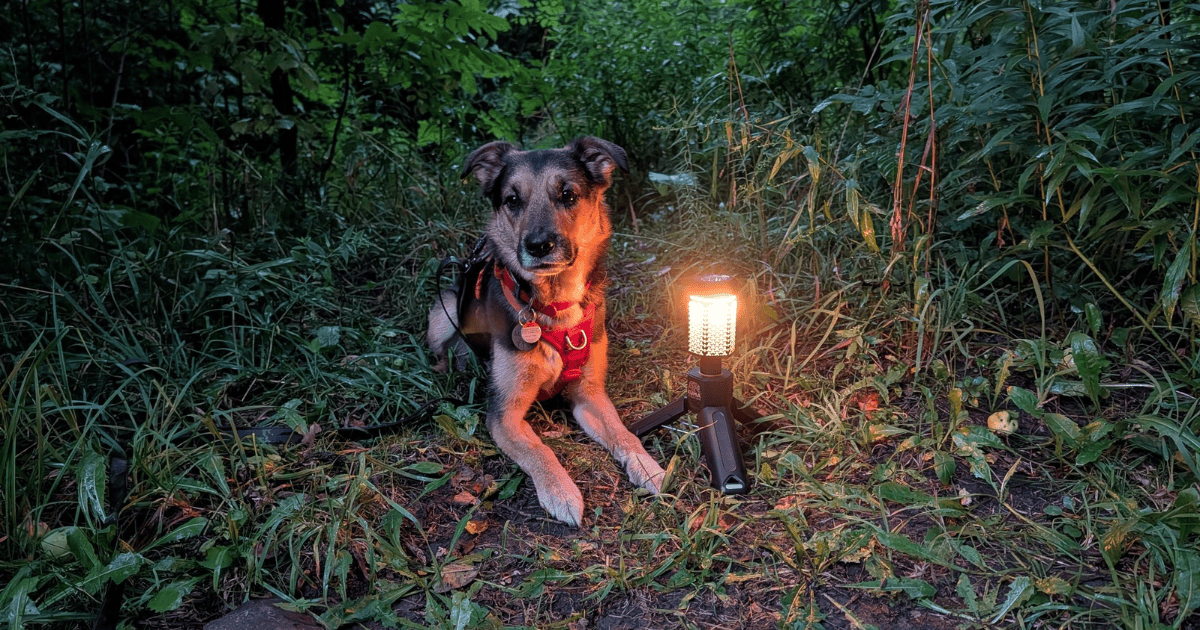
Our go-to lantern for ambient lighting is the KUMA Outdoor Gear Trek ‘N Glo Tripod Lantern.
We were sent this lantern earlier this season to test, and we took it on several trips before deciding whether to recommend it to all of you.
But we never expected it to become our go-to campsite light so quickly!
The warm light mode on this actually makes it look like it is a small fire-lit lantern burning near you, without having to deal with replacing the mantle or worrying about a fuel source. Just plug it in and charge when the battery runs low.

We also have a string light set, in warm white, that we use in the tent. It has a central light to hang in the tent, plus a string of warm white lights that give a soft glow around the tent and the garage area.
Bonus: There is a remote, so you don’t have to get out of your warm sleeping bag to turn off the light at the end of the night.
You can buy them on Amazon.
To hang it, we use magnetic hooks, a trick we saw someone share on social a couple of years ago (although I can no longer remember who it was, unfortunately, or I would give them credit).
This keeps the lights up safely where the pets aren’t going to trip over or get snagged in them.
Note: We did use more lighting when we were camping with senior dogs in the past to help avoid any anxiety they would feel from not being able to see what’s around them as well.
Task-Specific Lighting
If you have ever tried to cook at camp in the dark, then you know that lighting can make a big difference!
One of John’s favourite activities at camp is cooking. So, we are always keeping that in mind when packing for our trips.
Luckily, we have a lantern that is PERFECT for situations like this: the KUMA Outdoor Gear Northstar LED Flexlite.
This is another lantern that was sent to us by KUMA to test earlier this season.
Unlike the Trek ‘N Glo Tripod Lantern, this one is far brighter. In fact, I don’t think we will ever find a reason to use the brightest settings it offers!
But it has one feature I quickly fell in love with, and that’s the adjustable LED light arms.
Rather than lighting up the whole campsite (or your neighbour’s campsite) just to see what you’re doing on the picnic table, you can simply direct the light exactly where you need it.
There are several ways you can use it, depending on your campsite set-up:
- The flat base allows it to sit like a traditional tabletop lantern
- Hang it from your dining shelter using the hook on the bottom
- Mount it to a tent pole or other metal surface with the magnetic base
This lantern has also been a lifesaver when we pulled into a campsite late on one trip and had to set up in the dark, making it easy to illuminate what we were doing without disturbing those camping around us.

Lighting on the Move
One of the “must-have” items for any camping checklist is a flashlight.
Of course, as pet parents, there are times when your hands simply aren’t free to carry that flashlight around…
Nighttime bathroom breaks, anyone?
For this reason, we are huge fans of using a headlamp on our adventures. That way, you can light your way and stay hands-free to clean up after your pet, open tent zippers, untangle tie-outs, and more.
We have used several different headlights over the years and loved every one of them. However, I can’t say any one brand has stood out.
A few things to look out for when you’re shopping (from my experience):
- Easy to adjust light beam (angling up or down)
- Water resistance (in case it rains)
- Red-light mode to keep your natural night vision
- Rechargeable battery life
If you have a favourite headlamp brand, we’d love to hear about it! Drop your recommendations in the comments and we’ll check them out.
As for our pets, we do outfit them with lighting at night too, for a little added nighttime safety.
Both our dogs wear the NiteHowl Rechargeable LED Safety Necklace at night, while Theia wears a Nite Ize SpotLit Collar Light clipped onto the back of her harness.
This lets us see them moving around the campsite, making it easier to check on them at any time.

The Etiquette of Campsite Lighting
Of course, we can’t talk about lighting options without touching on the importance of campsite etiquette, respecting other campers and the wildlife that call these areas home.
Being a Respectful Neighbour
Many people go camping specifically to disconnect and escape all the lights of the city. A campsite lit up like a neon sign can quickly ruin that experience.
A few things you can do to be more mindful of the people around you include:
- Turning off all lights when you go to bed
- Shield lanterns so they don’t shine into nearby tents, hammocks, or camper windows (or get lights you can direct, like our lantern)
- Avoid using excessive lighting that extends beyond your site
- When walking, keep flashlights and headlamps pointed at the ground in front of you, not lighting up other people’s campsites
Protecting Nocturnal Ecosystems
The conversation about lighting etiquette usually focuses on other human campers, but what about local wildlife?
We are adventuring into their habitat and need to be mindful of our impact.
If you’re familiar with the Leave No Trace Principles, this would fall under Principle 6: Respect Wildlife.
Excessively bright lighting can have just as much of an impact on the local ecosystem as leaving trash behind or blasting loud music.
It can disorient nocturnal insects, amphibians, migrating birds, and mammals foraging at night.
They call it “Light Pollution” for a reason.
Dark Sky Principles for Campers
Are you looking for ways to minimize your impact on the local wildlife on your next camping adventure?
Beyond just “turn down the lights,” here are a few tips:
- Use lighting as needed. You can use brighter lighting for tasks like cooking or preparing food, but turn it off when you’re done.
- Direct any lighting toward the ground at your feet and paws. If your lighting isn’t directional, consider shielding it with a piece of cardboard or something similar.
- As I already mentioned, turn off your lighting at night. If you’re worried about being able to see when you go to the bathroom, keep a headlamp close at hand in your tent or trailer for nighttime runs.
- Consider warmer-coloured lights. Cool white and blue light scatters more and directly impacts melatonin levels in humans and animals. Instead, stick with warm amber and red lights.
A few simple changes can make a big difference. If you love nature as much as we do, it’s an easy sacrifice to make.

Keep the Wilderness Wild (and the Guylines Visible)
Being a respectful camper doesn’t mean you have to pitch your tent in pitch-black or feel around the campsite at night while taking your dog out for the final potty break before bed.
By choosing your gear carefully, aiming lights only where they’re needed, leaning into warm ambers, and shutting everything off when you turn in for the night, you can protect the local wildlife and the experience of other campers around you.
Give yourself the opportunity to enjoy the real magic of night at camp: the stars!
Do you have any must-have gear for lighting your adventures? We’d love to hear about it in the comments!
